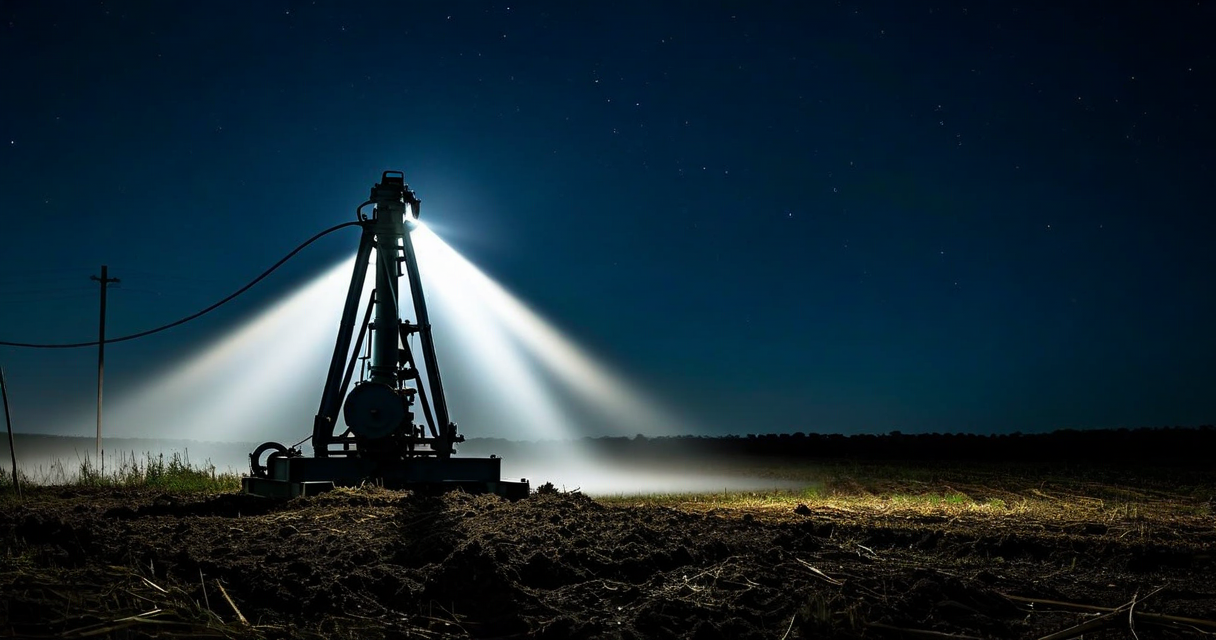
The Overnight Failure Pattern
FarmHQ's event log data from deployments across Oregon and Idaho shows a non-random distribution of pump failure events across the 24-hour clock. Unexpected pump stops — events where the pump goes from running to stopped without a user command or a scheduled stop — cluster between midnight and 4 AM local time. Roughly 41% of unplanned stops in the dataset occurred during that 4-hour window, which represents only 17% of the day.
The reason isn't mysterious. Rural agricultural grid power sees its most volatile behavior in the early morning hours, when industrial demand drops off and distribution utilities switch between generation sources. Voltage sags, micro-interruptions of less than half a cycle, and phase imbalances on 3-phase lines are all more common from midnight to 4 AM than during daylight operating hours. A pump motor running at 97% of rated voltage when a voltage sag drops it to 88% for 200 milliseconds will often trip its overload relay — a sag that wouldn't cause any issue in a data center causes a pump stop in a farm field.
The second contributing factor: overnight is when nobody is checking. A pump that stops at 2 PM is noticed within minutes — someone is at the field, or the farmhand does a visual check on rounds. A pump that stops at 2 AM runs dry (or sits stopped) for 6-8 hours before anyone realizes it. That extended undetected downtime is what converts a minor fault event into significant crop damage or pump hardware damage.
What the Alert Data Actually Shows
Across FarmHQ monitored sites during the 2024 irrigation season, the breakdown of after-dark pump fault events (6 PM to 6 AM) looks like this: power interruption events (pump lost voltage) accounted for 46% of after-dark stops. Overload trip events (thermal protection activated) accounted for 31%. Pressure-low events (pressure dropped below threshold during a scheduled run) accounted for 14%. All other causes — manual stops that weren't expected, low-water alerts from submersible pump switches — made up the remaining 9%.
The power interruption events were predominantly brief — 78% were resolved within 10 minutes as grid power was restored. But in that 10-minute window, the pump is stopped and the irrigation schedule has been disrupted. Without an alert, the grower doesn't know about it until morning. With FarmHQ's unexpected-stop alert, they receive an SMS within 60 seconds of the event and can verify from bed whether the pump self-restarted (some panels have auto-restart timers) or whether intervention is needed.
The overload trip events are more serious because they indicate a condition that needs on-site investigation — a motor running too hot, a bearing beginning to fail, or a voltage imbalance condition that's been stressing the motor. Unlike power interruptions, overload trips don't self-clear. An overload trip alert at 2 AM is worth calling your pump technician about at first light rather than waiting to find out what happened during the morning field walk.
Configuring Your Alert Windows Effectively
The default FarmHQ alert configuration sends all alert types to all registered phone numbers 24 hours a day. For most users, that's appropriate — you want to know immediately when something goes wrong, regardless of time. But for operations where there's someone physically closer to the pump site (a farmhand, a neighbor, an irrigation contractor with an on-call arrangement), the alert routing can be configured to send overnight alerts to that person as primary contact rather than to the farm owner who may be 45 minutes away.
The priority configuration that works best for overnight failure detection: set unexpected-stop alerts to high priority (immediate SMS + app notification). Set pressure-low alerts to high priority (same). Set expected-stop alerts (pump stopped per schedule) to low priority (no immediate notification). This prevents the alert system from becoming noise — every scheduled stop sending a notification trains you to ignore notifications, which defeats the purpose.
For growers who want to sleep through low-severity events but wake up for serious ones: FarmHQ's alert severity levels allow you to configure quiet hours with an exception for high-severity faults. Set quiet hours from 10 PM to 6 AM, with an override for unexpected-stop and pressure-low events. You'll sleep through scheduled events and routine notifications; you'll wake up for actual failures.
Power Quality Monitoring as an Early Warning Tool
If your site experiences frequent overnight power interruptions — more than 2-3 per season — it's worth investigating whether the underlying power quality issue is causing gradual damage to your pump motor before a catastrophic trip occurs. Frequent voltage sags stress motor insulation; over a 3-5 year period, a motor operating in a high-sag environment will fail sooner than the same motor in a stable power environment.
FarmHQ's event log provides the timestamp and duration data for every power interruption event. If you're seeing a pattern — the same time of night, the same magnitude, the same duration — that suggests a specific grid condition rather than random grid noise. That information is worth bringing to your rural electric cooperative: they can place a power quality monitor on your service line and assess whether the sag pattern indicates a distribution infrastructure issue that merits correction.
In several FarmHQ deployment areas, growers who identified persistent power quality issues through FarmHQ event logs and raised them with their rural electric co-op received transformer upgrades or distribution line work that resolved the issue. The FarmHQ event log gave them the data needed to make a documented case rather than a complaint based on impression.
Setting Up the Complete Overnight Protection Stack
The complete overnight fault detection setup for a FarmHQ-monitored pump station includes: the core FarmHQ module for pump status, command, and pressure monitoring; a current transformer on one phase for dry-run detection (current drop below threshold); FarmHQ's digital input connected to the VFD or motor starter fault relay; and alert routing configured with appropriate quiet hours and severity levels.
That complete stack catches: unexpected stops from power interruptions (core module), overload trips (fault relay input), dry-run conditions (current transformer), and pressure anomalies indicating downstream failure (pressure transducer on the discharge line). Anything that goes wrong overnight with the pump or the water delivery system produces a timestamped alert within 60 seconds of the event.
The overnight protection stack doesn't prevent failures — nothing does. But it limits the window between failure and discovery to under 2 minutes rather than 6-8 hours. That's the difference between a pump trip that costs you 90 minutes of irrigation schedule adjustment and a pump trip that costs you a crop row. If you're running overnight irrigation schedules and haven't configured overnight alert coverage, it's worth setting up before the next peak season. Setup is covered in the FarmHQ installation guide, and the support team at [email protected] can walk through the specific configuration for your operation.