Why Lowercarbon Capital Backed an Irrigation Hardware Company
Lowercarbon Capital focuses on companies that remove or avoid CO₂ at gigaton scale. Agriculture accounts for roughly 10% of US greenhouse gas emissions, and a significant share of that comes from diesel-powered pumping — running pumps longer than necessary because nobody is watching them. When a grower can see exactly how much water went into the soil and stop the pump at the right moment, fuel consumption drops and water withdrawals drop. That's the thesis Lowercarbon Capital invested behind with FarmHQ's $4.2M seed round.
The round closed in March 2025. Funds go toward expanding hardware production capacity, adding cellular coverage partnerships in the Central Valley and High Plains, and building out the reporting module that water districts in Oregon and Idaho have been asking for since FarmHQ's early field deployments.
What the Money Actually Pays For
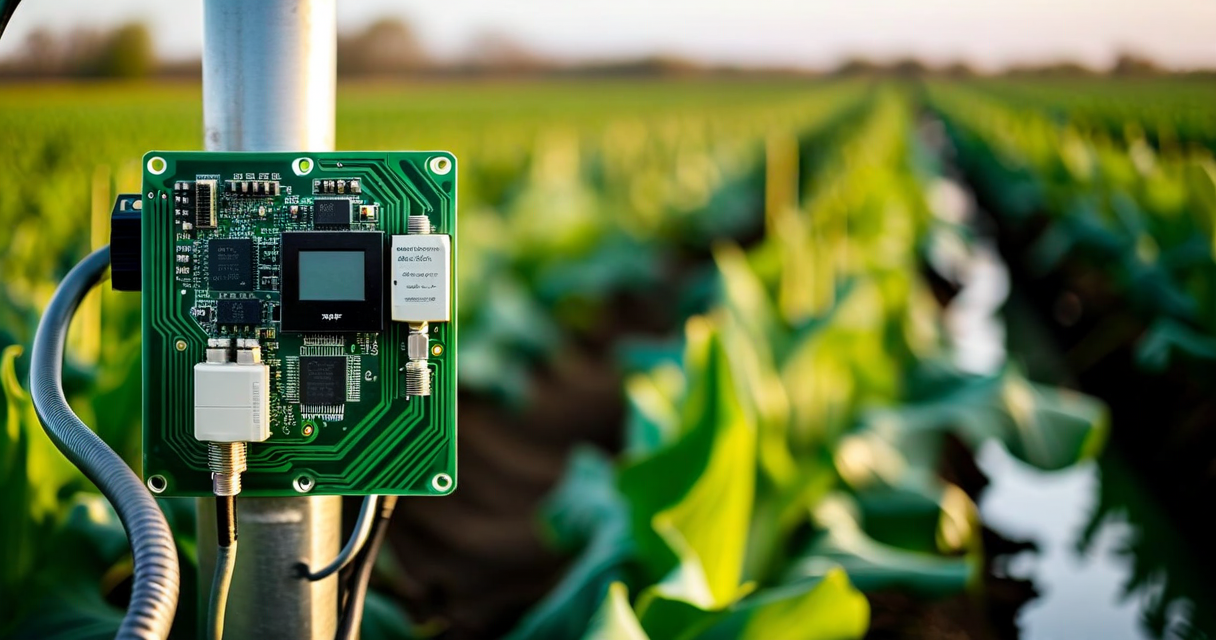
Hardware at this scale is expensive to build correctly. The FarmHQ module lives in a weatherproof enclosure rated to IP67, operates on 4G LTE Cat-M1 or NB-IoT depending on coverage, and has to survive temperature swings from -20°F to 120°F in a pump shed. Getting that right requires custom PCB runs, burn-in testing, and a field return process for units that fail during the first season.
A meaningful portion of the seed round funds that production cycle. The rest covers cellular data plan agreements — FarmHQ runs on a managed data plan that passes through T-Mobile's agricultural IoT program, which provides better rural coverage than consumer SIM plans — and the server infrastructure that handles command routing with sub-2-second latency.
The engineering team is also two hires away from shipping a multi-zone valve controller, which is the most frequently requested feature from orchardists running drip systems. That feature adds complexity: you're managing up to 8 valve zones independently from one module, each with its own schedule and soil probe channel. The seed funding accelerates that development timeline from late 2026 to mid-2025.
The Origin: Four Seasons of Driving to Check a Pump
FarmHQ started because of a specific frustration. David Wallace spent four seasons making a 90-mile round trip once a week to physically check on irrigation pumps at a family orchard in Eastern Oregon. On one of those trips, the pump had been running dry for three days. The impeller was damaged, the soil around the pump site was bone dry, and the orchard had lost one row of young trees to heat stress.
The immediate response was to wire up a cellular module using off-the-shelf components from the industrial automation industry. It worked well enough to prove the concept: you could get an SMS when pressure dropped and remotely cut power to the pump. Over the next two seasons, the system got rebuilt three times as the failure modes became clear — cellular signal margin at the field edge, relay contact welding, enclosure water ingress after a hose-down. Each rebuild made the hardware more reliable.
By the time the design was stable, several neighboring growers had asked to run the same system on their properties. That's when FarmHQ became a company rather than a farm project.
Current Deployment Geography
As of March 2025, FarmHQ hardware is running at active farm operations in Oregon, Idaho, Washington, and California. The Pacific Northwest represents the majority of the installed base — the Columbia Basin in particular, which has some of the highest pump density per acre of any irrigated region in the US.
The Central Valley expansion is the primary near-term target. California's Sustainable Groundwater Management Act (SGMA) is requiring water districts to account for well pumping with increasing precision. Growers who can export pump-hour logs with timestamps have a compliance advantage over those keeping paper records. FarmHQ's reporting module produces those records automatically as a side effect of normal remote monitoring operation.
The High Plains expansion — covering Kansas, Nebraska, and the Texas Panhandle — is further out. Coverage there depends on Cat-M1 availability from T-Mobile's agricultural IoT program, and signal density across the Ogallala Aquifer region is patchy. FarmHQ is participating in a T-Mobile pilot to improve coverage maps before committing to that geography.
What FarmHQ Is Not Building
A few things are not on the roadmap. FarmHQ is not building a drone integration. It's not building AI-driven crop models. It's not building a marketplace or a data brokerage. The company is focused on one thing: making it possible for a grower to know what's happening at the pump right now, and to take action without driving to the field.
That scope discipline is intentional. The irrigation control market has a long history of products that tried to do too much and ended up being too complex for the people who needed them most. A grower managing 800 acres of potatoes in Klamath County doesn't want a subscription to an agronomic platform — he wants to know if the pump is running and to be able to turn it off from his kitchen table at 11 PM.
What Comes Next
The multi-zone valve controller ships in Q3 2025. The California water district reporting module — which maps pump hours to estimated diversions using flow rate calibration — is scheduled for Q2 2025. A battery-backed operation mode for areas with unreliable grid power is planned for Q4 2025.
The seed round also enables FarmHQ to build a formal dealer network. Currently, most hardware is sold direct. Building a network of certified irrigation dealers who can install and support FarmHQ modules would allow the company to reach growers who prefer vendor relationships over self-installation. The dealer certification program is in design as of this writing.
To stay current on product releases and coverage area expansions, sign up for updates via the contact page or reach out to [email protected] with questions about your specific operation.
What Growers Should Know
If you're already using FarmHQ hardware, the seed funding doesn't change your service agreement or pricing. Existing customers will be first to access the multi-zone valve controller beta. If you're evaluating FarmHQ and wondering about long-term viability — that's what a funded seed round addresses. The company has 18+ months of runway to ship the multi-zone controller, expand the dealer network, and build the compliance reporting module without needing to rush a follow-on raise.
Questions about whether FarmHQ works with your specific pump setup? The installation guide covers the most common pump controller types, and the support team is reachable at [email protected] for anything outside the standard cases.